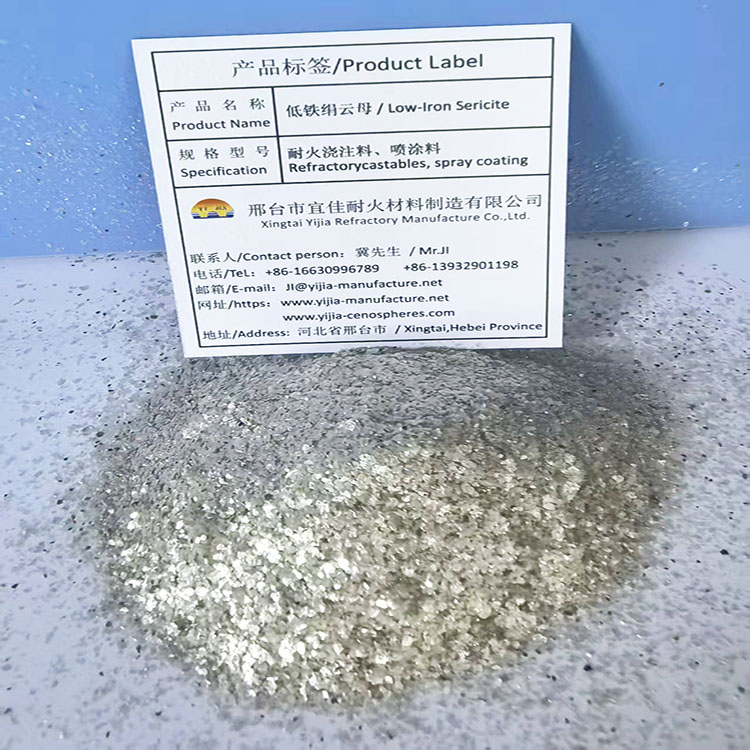
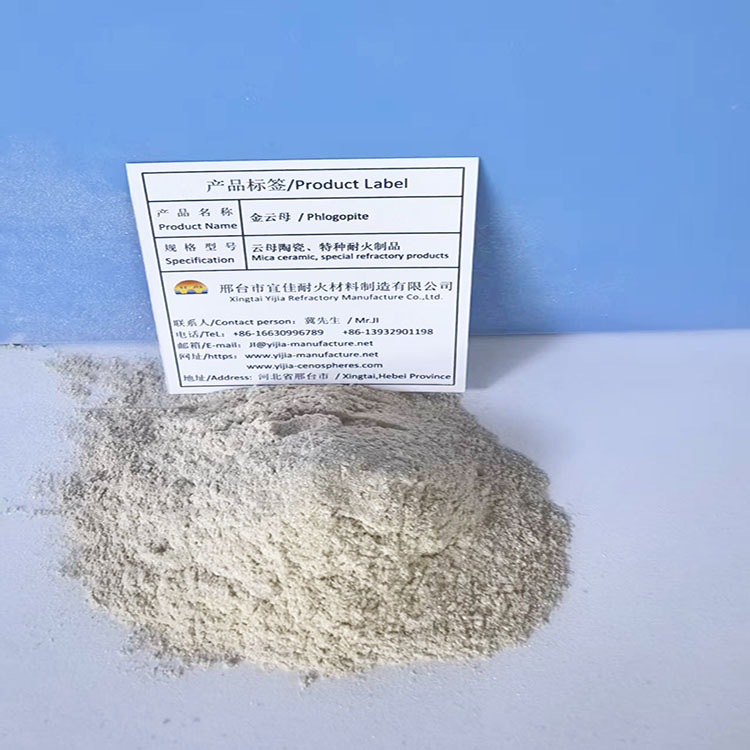
Low-iron sericite is a naturally occurring phyllosilicate mineral, a high-quality variant of sericite (fine-grained muscovite). Its core feature is extremely low iron oxide (Fe₂O₃) content, making it a highly valuable functional filler and reinforcing material in high-temperature applications—especially refractories and coatings with strict color and high-temperature performance requirements. It not only improves material application and processing properties but also significantly enhances their high-temperature service effect and lifespan.
-
Excellent high-temperature resistance: With a high melting point (about 1300-1400℃), it maintains structural stability at high temperatures and is not easy to decompose. As a stable "skeleton" or matrix component in refractories, it helps maintain material structural integrity under high temperatures.
-
Flaky structure and interlayer bonding force: It has a typical two-dimensional flaky structure with weak interlayer bonding. At high temperatures, a small amount of bound water is released between layers, producing a micro-expansion effect. This micro-expansion can partially offset shrinkage during material sintering, prevent cracking, and improve thermal shock resistance and volume stability.
-
Extremely low iron content: The key indicator of its "low-iron" grade. Iron is the main impurity forming low-melting phases and coloring (usually yellow, brown) at high temperatures. Low iron content means higher refractoriness (avoiding excessive glass phase formation to maintain high-temperature strength), light appearance (especially suitable for shaped or unshaped refractories requiring white or light-colored matrix), and reduced pollution (avoiding iron contamination in applications contacting high-purity metal or glass melts).
-
Good chemical inertness: Resists most chemicals, especially molten alkalis and some slags.
-
Reinforcement and toughening: Its fine flaky structure acts like "micro-reinforcement" in the matrix, overlapping and bridging to disperse stress, prevent microcrack propagation, and improve material mechanical strength and toughness.
As an additive or key matrix component, it is used in:
-
High-performance unshaped refractories: Such as refractory castables, plastics, ramming mixes, etc.
-
Shaped refractory products: Such as special refractory bricks.
-
Refractory fiber products: As a bonding and reinforcing component.
Coatings are an important application form of unshaped refractories. Low-iron sericite plays a crucial role in them: improving adhesion rate and rebound rate, enhancing spray workability (rapid strength development), and optimizing coating structure.




 邢台市宜佳
邢台市宜佳 邢台市宜佳
邢台市宜佳
 Lankecms